
“While he was considering these things, behold, an angel of the Lord appeared to him in a dream and said: ‘Joseph, son of David, do not be afraid to take Mary as your wife. For the child conceived in her is from the Holy Spirit; she will bear a son and you shall name him Jesus: for he will save his people from their sins’“.
(Mt 1:20-21)
A gift that sustains
There are figures who move through history without making noise. They do not speak, do not put themselves forward, and do not seek space. Yet, without them, many things simply would not exist. Saint Joseph is one of these.
In the Gospel we find no words spoken by him. There are no striking gestures, nor actions that can be read as a “gift” in the most immediate sense of the term. Yet his entire presence is a gift. But it is a different kind of gift. A gift that cannot be seen.
In fundraising, the gift is almost always associated with something concrete: an amount, a contribution, something measurable.
If we try, however, to shift our gaze, the figure of Saint Joseph becomes even more relevant. He is not a donor and does not financially support a project. Joseph does not give resources: he gives himself, his time, his presence, his ability to take on responsibility in concrete terms. In many respects, this form of gift recalls that of those who place themselves in service through volunteering.

Not a gesture, but a presence
Joseph accepts a situation he did not choose, takes on a responsibility and carries it forward over time, without conditions.
In nonprofit organizations, volunteering often occupies a very important position but is not always central to the narrative. Projects are described, results are shared, fundraising campaigns are highlighted. Major donors are valued, relationships are built, impacts are measured.
But there is a part of the system that remains more “hidden.” These are the people who give their time, keep spaces open, welcome, organize, accompany. Without them, many activities simply would not function.
There is an element that profoundly connects Joseph and volunteering: the gift is not an act, but a position.
People who volunteer do not “make a donation.” They make themselves available. They do not intervene once but remain in the everyday, and this completely changes the logic of the gift. It is not simply “doing,” but knowing how to be present. Because the value lies not in the single gesture, but in continuity: being there when needed, when nothing is happening, being there without need for recognition. It is a form of gift that is less visible, less measurable, but often more structural.
There is also another interesting aspect that brings Joseph close to those who volunteer. Joseph protects without putting himself forward. He does not seek space, does not take the floor, does not place himself at the center. Many people engaged in volunteering live out service in the same way: they do not seek visibility and do not want to be highlighted.
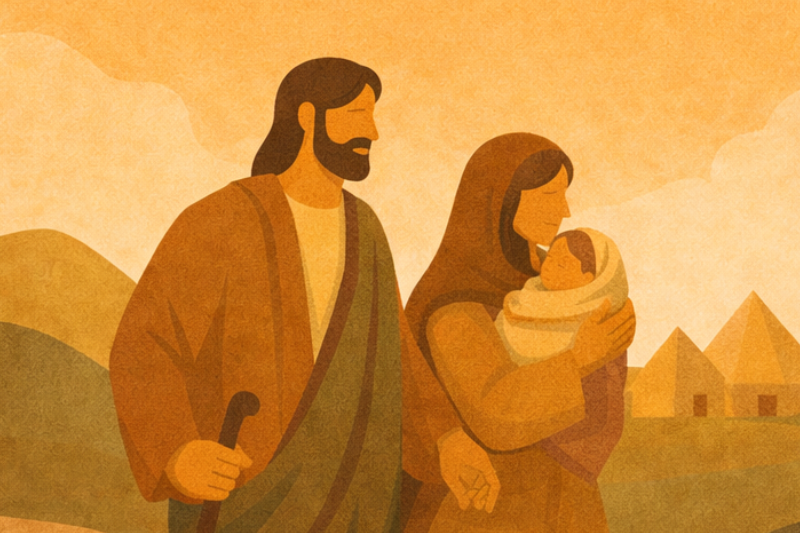
Protecting, without appearing
The figure of Saint Joseph helps us pose a question: how much space do we give, in our organizations, to what is not immediately visible? To volunteers who ask for nothing, to those who support without putting themselves forward, to those who do not fit into the more structured relational models?
Because not all value can be measured. And not everything that holds a project together comes from a donation.
In fundraising there is a tendency to look at what generates resources. But every organization also has another structure, less visible: one made of presence, time, responsibility.
Saint Joseph does not build a project but holds a story together. And perhaps this is precisely the point. What truly sustains, at times, cannot be seen.