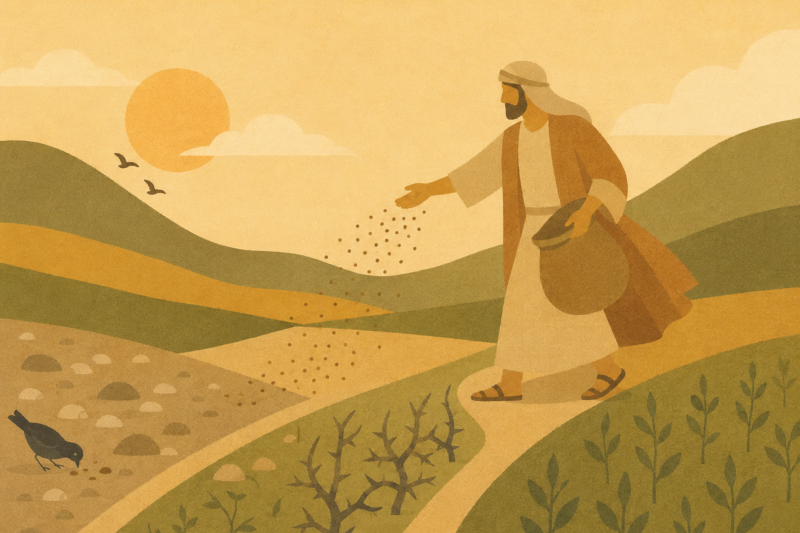
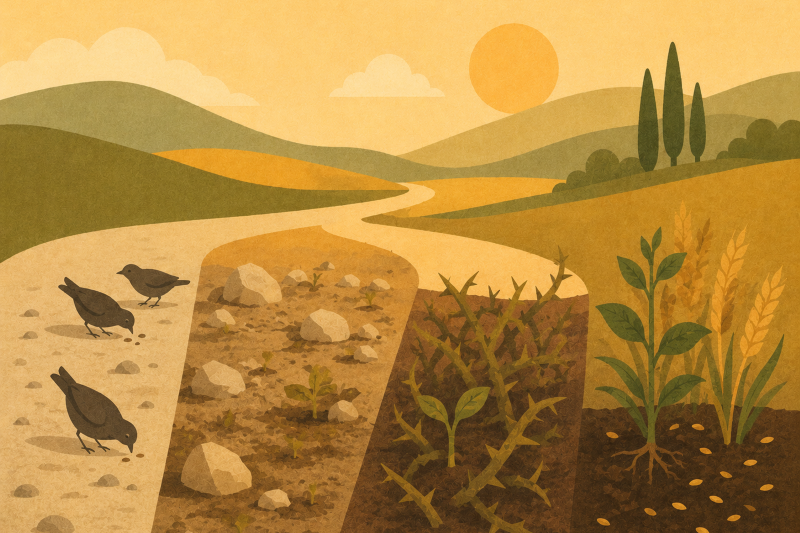
“A sower went out to sow his seed. And as he sowed, some fell along the path and was trampled underfoot, and the birds of the air devoured it. And some fell on the rock, and as it grew up, it withered away, because it had no moisture. And some fell among thorns, and the thorns grew up with it and choked it. And some fell into good soil and grew and yielded a hundredfold.”
(Lk 8:5-8)
The Parable of the Sower
Among the parables told by Jesus, that of the sower is probably one of the best known. A man goes out to sow and part of the seed is lost: it falls on the path, on the rock, among the thorns. Only a part actually reaches the good soil and produces fruit.
Upon a first reading, the sower’s behavior might seem inefficient. Why sow everywhere? Why not focus exclusively on the most fertile soil?
In reality, it is precisely this apparent inefficiency that offers us an interesting perspective for reflecting on the culture of giving and on fundraising.
Beyond the logic of immediate results
We live in a time where we are used to measuring everything in terms of results. How many donations have come in? How many donors have responded? Which campaign worked best?
The Parable of the Sower invites us instead to look at the process before the result.
The sower carries out his work with confidence. He knows that not all seeds will bear fruit and that some will be lost, yet he continues to sow.
Those involved in fundraising also find themselves living this experience. Not everyone we meet will become a donor. Not all initiatives will produce the hoped-for response. Not all communities will immediately develop a culture of co-responsibility and financial support.
The gift, like the seed, cannot be forced.
Cultivating the good soil
The Parable describes three situations in which the seed fails to grow.
There is the soil of the path, where the seed finds no room to take root. In the life of our organizations, this can happen when the message fails to create an authentic connection with people. A need is communicated, but a relationship is not built.
Then there is the rocky ground, where the seed sprouts quickly but does not have sufficient roots to endure. It is the image of superficial involvement, of a momentary enthusiasm that does not transform into lasting participation.
Finally, there are the thorns, which choke the plant’s growth. Even in our realities, there are “thorns” that risk choking the gift: a lack of trust, poor transparency, the perception that the requested contribution does not produce real change.
In all these cases, the problem is not the seed; the problem is the “soil.”
When we talk about fundraising, we often think of tools: campaigns, events, digital platforms, newsletters, social media. All important elements, but none of them is the true starting point. The Parable reminds us that the fruit is born from the quality of the soil.
For this reason, fundraising cannot be reduced to a simple collection of financial resources. It is, first and foremost, a work of building relationships, trust, and belonging.
The good soil is a community that understands the mission, shares its values, and feels part of a larger project. The good soil is the donor who does not just support an activity but identifies with a vision. The good soil is a relationship cultivated over time through listening, transparency, and care.
The task of the one who “sows”
In the Parable, the sower does not control the harvest. He can sow, he can have faith, he can continue to do his work, but he cannot force the seed to grow.
Those who work in fundraising know this limitation well.
We cannot impose generosity. We cannot demand the gift. We cannot control people’s response.
We can, however, create the conditions for the gift to become possible. We can authentically tell the story of the mission entrusted to us. We can bear witness to the impact of our projects. We can care for the relationships entrusted to us. We can prepare the soil.
Finally, the Parable of the Sower invites us to a deeper reflection. The question concerns not only the one who sows, but also each of us.
What kind of soil are we building in our communities? Are we fostering a culture of co-responsibility, or do we continue to consider giving as a secondary issue, to be addressed only in times of difficulty?
Ultimately, fundraising does not simply consist of raising funds. It consists of generating participation around a mission.
Like the sower in the Gospel, we are called to continue sowing with confidence, knowing that not every seed will bear fruit, but also that no harvest will ever be possible without someone willing, first of all, to go out and sow.
Practical tools
Here are some concrete actions to “prepare the soil”:
- Cultivate relationships: people are more willing to support a mission when they feel involved and part of a community.
- Tell concrete stories: numbers are important, but it is the people and the changes generated that make the value of the mission visible.
- Be transparent: explain how donations are used to strengthen trust and encourage ongoing support.
- Always say thank you: it is not a formality, but the first step in building a lasting relationship with the donor.
- Involve: offer opportunities to participate, learn about projects, and feel co-responsible for the results.
- Be patient: just as the seed needs time to grow, the culture of giving is built slowly and requires consistency.
- Do not measure only donations: also value participation, volunteering, and all the ways in which a person supports the mission.
- Continue to sow: a community that stops sowing is unlikely to see new fruit born.