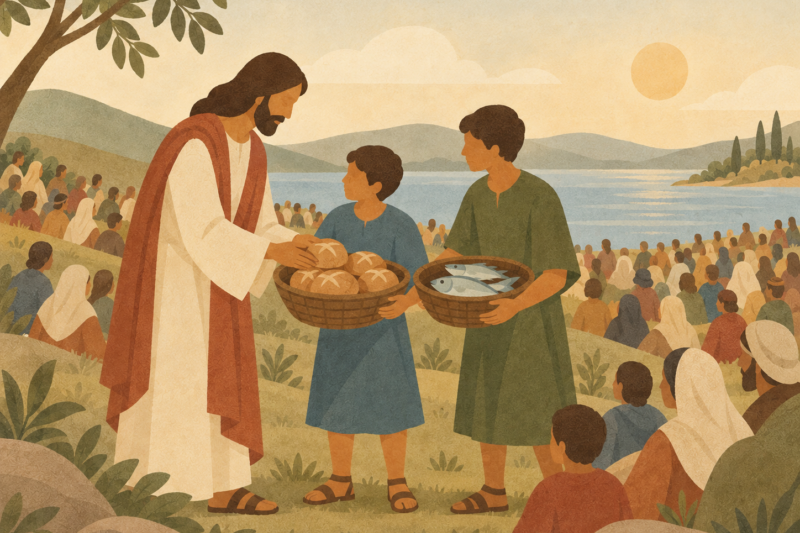
“In everything I did, I showed you that by this kind of hard work we must help the weak, remembering the words the Lord Jesus himself said: ‘It is more blessed to give than to receive.’”
(Acts 20:35)
The joy of giving
In the Acts of the Apostles, Saint Paul delivers a phrase to the community that seems to speak directly even to those who today deal with giving, mission, and fundraising: “It is more blessed to give than to receive.”
It is a simple statement, almost immediate, yet profoundly revolutionary. Because it overturns the way we are often accustomed to thinking about giving.
Many times we imagine giving as a sacrifice: making a portion of one’s resources available, choosing not to keep everything for oneself. And certainly, in giving there is also this. But the Word invites us to look deeper.
In giving there is not only a loss, there is a joy. Not a superficial joy, linked to the gesture of the moment, but a deeper joy, which arises from feeling part of something greater. Those who give do not simply perform an economic act. They enter into a relationship, participate in a mission, and contribute to generating life and care.
In this perspective, the gift does not impoverish the giver. On the contrary, it becomes an experience of “wealth.” It is precisely here that the verse from Acts offers a precious key for reinterpreting fundraising.
Helping the weak
Saint Paul does not limit himself to remembering the joy of giving; first, he says something very concrete: “By this kind of hard work we must help the weak.”
Helping the most fragile is not presented as an occasional gesture or as a simple emotion in the face of need. It is linked to work, responsibility, and concreteness.
This passage is very important because even in our way of thinking about charity, we risk, at times, stopping only at the spontaneity of the gesture. We see a need, we are moved, we do something, and it is certainly a good thing.
But many works of the Church, many missions, many educational, social, pastoral, or healthcare services cannot live on occasional generosity alone. They need continuity, organization, people, tools, planning, communication, relationships, and trust. In other words, they also need fundraising.
Fundraising, therefore, is not something external to the mission. It is not a technical activity to be placed on the margins of ecclesial life or works of charity. It is one of the tools through which a community makes service to the weakest possible over time.
A shelter, a soup kitchen, an educational project, a healthcare service, a path of spiritual or social accompaniment are not sustained by good intentions alone.
It requires patient, daily, often invisible work. There is a need for someone who knows how to communicate the need, build trust, involve people, safeguard relationships, and account for the impact generated.
Fundraising thus becomes a concrete form of responsibility toward the most fragile. It does not replace charity but makes it possible over time.

Those who give do not lose, they participate
If we look at fundraising only from the organization’s point of view, however, we risk seeing the donor simply as someone to ask for something. We have a project to support, an economic need, a mission to carry out, and so we look for someone who can help us.
If indeed “it is more blessed to give than to receive”, then the donor is not simply the one who responds to a request. They are a person who, through the gift, enters into a relationship with a mission and participates in a greater journey.
One of the skills of those who deal with fundraising is to recognize the value of a gesture and help the one who performed it recognize it too.
In this sense, the gift is not just a transfer of resources. It is a form of participation, and it is precisely this participation that can generate joy.

Fundraising at the service of the mission
“It is more blessed to give than to receive” is not just a beautiful phrase to remember. It is a key to rethinking the way we ask, thank, tell stories, and accompany.
Every request for a gift should be made with respect, but also with confidence. Because we are not just asking someone for something: we are offering the possibility of participating in a good work.
Perhaps this is precisely one of the most important challenges for those who deal with fundraising: not to limit themselves to collecting resources to support works, but to help people rediscover the beauty and joy of giving.
Because when giving is lived this way, it does not remain just an economic gesture; it becomes an encounter, a relationship, a shared mission.