
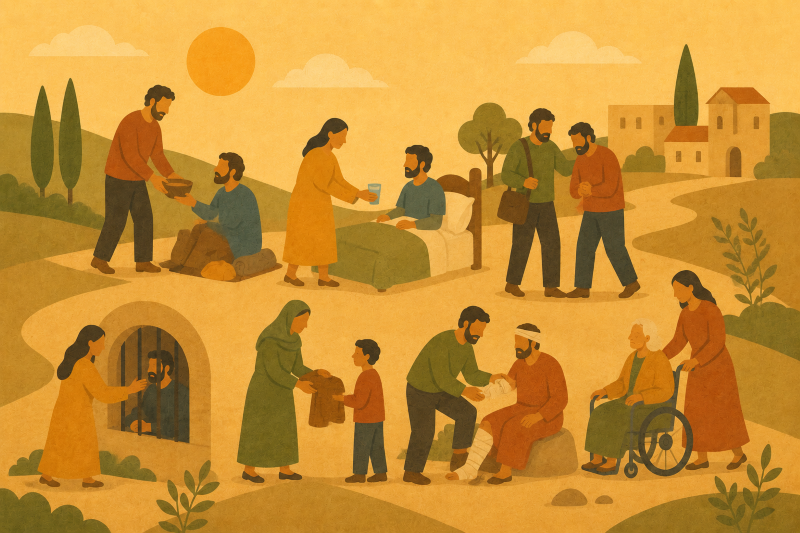
“For I was hungry and you gave me food, I was thirsty and you gave me drink, I was a stranger and you welcomed me, naked and you clothed me, sick and you visited me, in prison and you came to me.”
(Mt 25:35-36)
From works to development projects
The works of mercy are actions that, in the Christian tradition, help transform compassion into concrete responses to people’s needs. They are divided into corporal, meaning related to material needs, such as feeding, clothing, and welcoming, and spiritual, related to the inner dimension, such as comforting, counseling, and accompanying.
In both cases, they represent a simple and direct way to recognize a need and choose not to remain indifferent. These works have a characteristic that makes them always relevant: they are concrete. They are not abstract concepts, but actions.
Those working in the nonprofit sector today face a different challenge: how can we transform these actions into interventions that are not “only” an immediate response, but generate change over time while ensuring sustainability?

From need to objective
To understand how to transform a work into an action that lasts over time and generates impact, it is important to emphasize that every project is born from a real need. Even the works of mercy start from the direct observation of a vulnerability.
- “Feeding the hungry” = food insecurity
- “Visiting the sick” = access to care
- “Welcoming the stranger” = hospitality and inclusion
For a work to become a project, it is necessary to transform a need into a clear objective.
To better understand this point, we could also look to the Sustainable Development Goals (SDGs), 17 goals established by the United Nations to improve the world by 2030. They serve as a common guide for addressing concrete problems so that countries, organizations, and businesses work in the same direction.

Reading the works of mercy in relation to the Sustainable Development Goals should not be understood as a rigid framework, but rather as a common language, understandable at the level of international development and cooperation.
For example, “feeding the hungry” could correspond to Goal 2, relating to achieving zero hunger in the world.
The transition from work to objective outlines two very important aspects: it gives direction to the intervention and makes the project shareable with partners and donors.
From objective to project
After understanding the importance of thinking in terms of objectives, it is necessary to understand how to transform these objectives into projects. Below are the essential steps to follow.
- Definition of the need: it is not enough to say “there is poverty”; it is necessary to understand who is involved, where, and to what extent.
- Specific objective: it is not enough to want to “help.” Rather, we must ask ourselves: what do I want to change? In what timeframe?
- Concrete activities: it is important to define the concrete activities that will be at the heart of our project.
- Resources: define the human and financial resources and the relational capital available or to be developed and reached.
- Outcome indicators: if a project does not produce measurable and evaluable results, we will never be able to demonstrate its impact.
Next steps
Here are some key points to summarize this article into an operational process.
- Choose a work of mercy by identifying a real need.
- Connect it to an objective, also by referring to the SDGs.
- Define the change you want to generate.
- Structure the activities by defining the resources.
- Measure the results.
- Tell the story of the journey through communication.
Today the challenge is to transform a gesture into a system, a response into a journey, immediate help into a development process. And that is where a project capable of generating real impact is born.