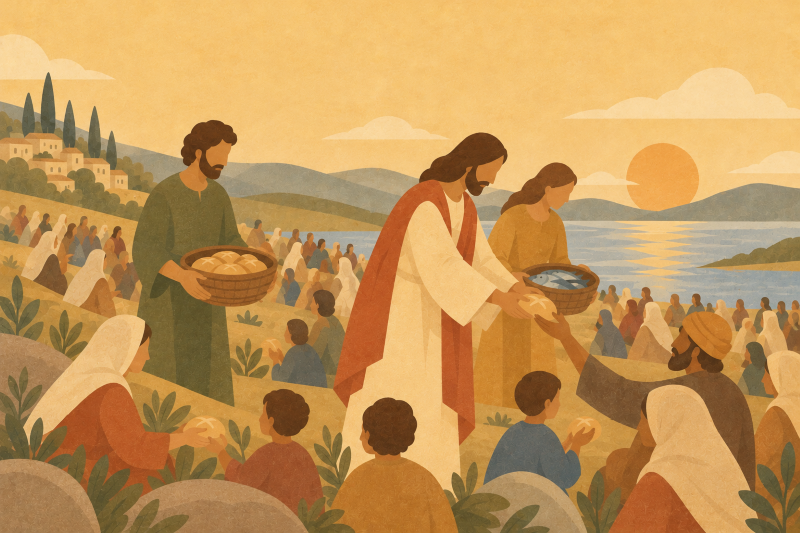
“When it was evening, the disciples came to him and said, ‘This is a deserted place, and the hour is now late; send the crowds away so that they may go into the villages and buy food for themselves.’ Jesus said to them, ‘They need not go away; you give them something to eat.’ They replied, ‘We have nothing here but five loaves and two fish!’ And he said, ‘Bring them here to me.’ Then he ordered the crowds to sit down on the grass. Taking the five loaves and the two fish, he looked up to heaven, and blessed and broke the loaves, and gave them to the disciples, and the disciples gave them to the crowds. And all ate and were filled; and they took up what was left over of the broken pieces, twelve baskets full. And those who ate were about five thousand men, besides women and children.”
(Mt 14:15-21)
Looking at What Is Missing
Faced with a crowd of thousands of hungry people, the disciples do what we probably would have done as well: they start doing the math.
“We have nothing here but five loaves and two fish,” far too little.
In reflecting on this Gospel passage, I would like to leave the miracle of multiplication in the background for a moment and pause right here, on what happens before.
The disciples look at what they have available and see primarily what is missing. Their attention is not directed to the five loaves and two fish, but to the disproportion between those resources and the need before them.
It is an understandable reaction that, in different forms, I have often encountered in our organizations as well.
“We are a small congregation. We have few donors. We do not have a large network of contacts. With what we raise we can do little.”
We look at what we have, compare it with the magnitude of the needs, and easily arrive at the conclusion that it is too little to truly make a difference. It is from here that I would like to begin speaking about fundraising.
Every donor, ultimately, makes available what they can. For some it will be 10 euros, for others 10,000. Some will offer time, others professional expertise. A business may make products available, a volunteer some hours of their week, a foundation the resources necessary to launch a project.
Each brings their own five loaves and two fish.
And perhaps the first task of fundraising is precisely not to consider a gift useless simply because, taken individually, it appears insufficient in relation to the magnitude of the need.

The Gift Is Not Yet the Impact
In fundraising we sometimes risk conflating two moments that are actually profoundly different: gathering a resource and generating change.
A donation of 100 euros is a resource; it is not yet a meal, a book, a medical visit, a scholarship.
For that resource to contribute to generating change, it needs to enter into a project, to encounter other resources, skills, people, and organizational capacity.
This distinction is important because it shifts our perspective. When a fundraising campaign does not reach its hoped-for goal, the first question is often: How can we ask for more? How can we increase the average donation? How can we find a major donor?
But perhaps we should ask ourselves “How capable are we of doing something with what people have already chosen to entrust to us?”
There is also a mistake we can make when we describe a need: transferring its entire weight onto the donor.
We need to build a school, we must support a hundred families, thousands of euros are needed to guarantee a service, and unconsciously we may make the person before us feel too small in relation to the scale of the problem.
What difference can my 20 euros make in the face of all this?
The answer of those engaged in fundraising should be: “You do not have to solve the problem yourself. You bring what you can, your five loaves and two fish.”
It is the organization’s task to welcome that gift, place it alongside other gifts, and incorporate it within a broader project.
This, in my view, is one of the most beautiful functions of fundraising: making possible a participation that individually would seem insufficient. None of the individual donors must “have enough bread to feed the crowd,” but each can participate with what they can make available.
.
Starting from What We Have
The fundraiser is not only someone who finds resources. They are also someone who helps create a bridge between availability and possibility.
On one side there is someone who says: “This is what I can make available.” On the other side there is a need calling for a response. In the middle there is an organization called to welcome that availability, relate it to other resources, and use it responsibly within a project.
And it is here that the “little” of each person acquires a different value. Not because the organization performs a multiplication, but because what individually would not be sufficient can become part of a response built together.
And it is not only about “spending well” the money received. It means planning, bringing together different resources, creating partnerships, avoiding waste, understanding needs, measuring what happens, and knowing how to communicate the change produced.
Fundraising is therefore not only the art of gathering. It is also the capacity to ensure that what is gathered finds its proper place within the organization’s mission.
At the end of the account twelve baskets remain. But I do not believe that, in speaking of fundraising, we must seek a parallel with the miracle.
That belongs to the Gospel and to the action of Jesus.