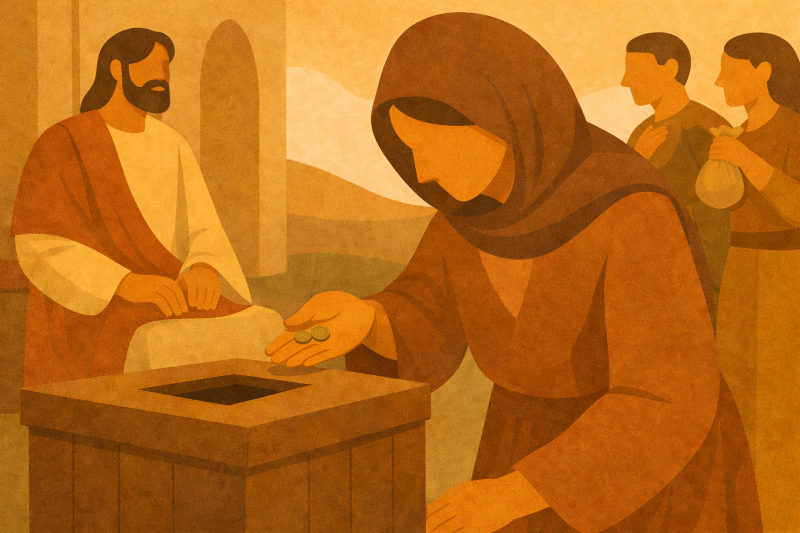
«He sat down opposite the treasury and watched the crowd putting money into the treasury. Many rich people put in large sums. A poor widow came and put in two small copper coins, which are worth a penny. Then he called his disciples and said to them, “Truly I tell you, this poor widow has put in more than all those who are contributing to the treasury. For all of them have contributed out of their abundance; but she out of her poverty has put in everything she had, all she had to live on”.
(Mk 12:41-44)
The value of the gift
The story of the widow highlights a very simple and at the same time deeply revolutionary principle: the gift is not measured only by its economic value.
In the Temple, everyone stops to observe how much people give. Jesus, on the other hand, looks at the donation from a completely different perspective, focusing on the relationship between what a person possesses and what they decide to give.
From a purely economic point of view, “two small coins” might not make any difference to our budget, but they can represent a very profound gesture for the one who offers them. At the same time, a “large” donation could have a different weight depending on the means of the person making it.
This Word therefore introduces a truly important concept when we talk about fundraising: the value of the gift is personal, meaning it is linked to the story of the giver.
Giving is relative
In fundraising, it is normal to use different categories to distinguish types of donors: small donors, regular donors, large donors, or major donors. These “classifications” help organize strategies, especially when carrying out actions on large numbers, placing a donation request in line with the giving capacity.
Organizations often tend to focus a lot of energy on major donors because they have an immediate impact on the budget. It is an understandable choice, but it risks losing sight of a fundamental element: many missions are sustained over time precisely thanks to a broad base of donors who contribute small amounts.
If we reread this “classification” starting from the Word, this story introduces a concept of the relativity of the gift: a “major donor” is never “major” in absolute value.
A “small” contribution can be a minimal amount for someone and a significant gesture for someone else. In this sense, the widow represents, paradoxically, the true “major donor” of the scene because she gives “everything she had to live on”.
Caring for the relationship
Looking at fundraising from this perspective means recognizing that fundraising is not just a matter of amounts collected, but above all of relationships built.
The story of the widow reminds us of exactly this: behind every gift, small or large, there is a person who has chosen to participate. And it is this participation that makes the life of many works and communities possible over time.
The task of the fundraiser, after all, is not only to collect funds, but to safeguard and accompany the act of giving. The true heritage of an organization is not, in fact, just the sum of the donations received, but the community of people who choose to participate in the mission.
Safeguarding this community means caring for the relationship with every donor, even when their contribution seems small. It is often precisely this silent network of support that makes the continuity of works possible over time.

How to value “small” donors
Religious organizations can also make some concrete and operational choices to value the gift.