
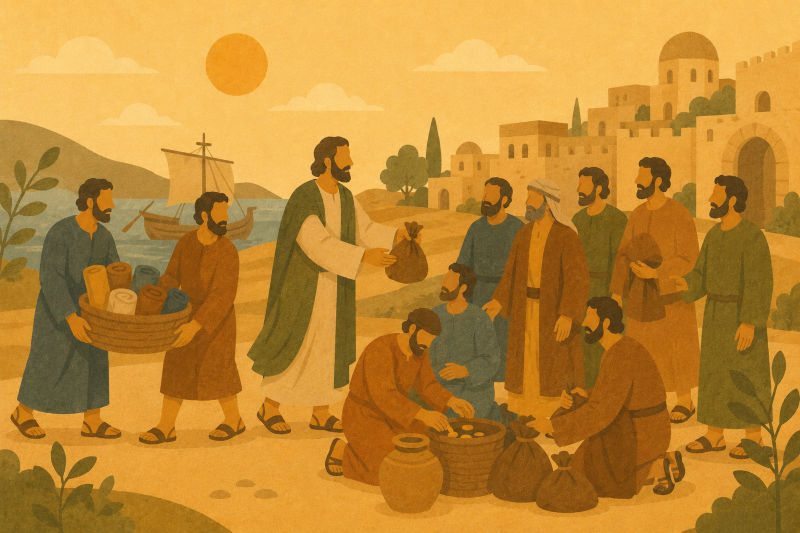
“Now concerning the collection for the saints: as I directed the churches of Galatia, so you also are to do. On the first day of every week, each of you is to put something aside and store it up, as he may prosper, so that there will be no collecting when I come. And when I arrive, I will send those whom you accredit by letter to carry your gift to Jerusalem. If it seems advisable that I should go also, they will accompany me.”
(1 Corinthians 16:1-4)
The Jerusalem Collection
The collection for the poor of Jerusalem is one of the most interesting cases of fundraising in the New Testament. Saint Paul speaks of it in several passages of his letters, and what emerges is not just an invitation to generosity, but a true pastoral and organizational process: preparation, donor accompaniment, transparency, and the relationship between communities.
It is now clear: fundraising cannot be considered merely a request made when needed. For fundraising to work, it needs strategy, planning, and tools. We build campaigns, work on key moments, activate donations, and try to accompany donors over time.
Rereading the passage from the First Letter to the Corinthians, Saint Paul makes us reflect precisely on the importance of planning. Saint Paul does not ask for donations “when needed.” He asks to set something aside every week, with regularity. In Saint Paul’s text, there is no urgency, no pressure, but rather a construction over time. Saint Paul seems to suggest that the gift arises from a choice that becomes a habit.
It is not just a matter of effectiveness. It is a matter of the quality of the relationship with the donor.
The Donor Before the Donation
There is then a second element, subtler but decisive, which we also find as a common thread in the text of the widow and the alms. There is no equal quota for everyone. There is no minimum threshold. Everyone contributes according to their means.
“Each of you is to put something aside and store it up, as he may prosper.”
In fundraising, this completely changes the perspective. Because it shifts the focus from the amount to the participation.
In our daily work, and especially in highly structured organizations, we find ourselves “classifying” donors based on the amount of the donation. Saint Paul, however, reminds us of a fundamental point: the donor matters before the donation.
There is another element that points toward the strategic planning of fundraising. Saint Paul writes that the collection must be made before his arrival. Not during, nor at the moment of greatest involvement.
Saint Paul voluntarily gives up the moment when it would be easiest to collect. Yet the meaning is clear: to prevent the donation from arising from pressure or momentary enthusiasm, thus leaving room for the freedom of the gift.
When Trust Is Built
Another aspect concerns the management of the collection. Saint Paul does not centralize; he does not propose himself as the sole guarantor but asks the community to choose the people tasked with carrying the gift.
It is a very concrete step, yet extremely relevant today. Trust is not requested; it is organized.
In the non-profit sector, we often speak of transparency. But transparency is not just communication. It is structure. It means creating conditions in which those who give can see, understand, and recognize how resources are being used.
It is a slower process. But it is also what makes a relationship solid over time.
The collection for Jerusalem is not just a transfer of resources. It is a way to hold different communities together. To build a concrete bond between those who give and those who receive. In this sense, fundraising becomes a relationship.
And perhaps it is precisely here that the Pauline text invites us to shift the question: no longer “how much are we raising?”, but “what kind of relationship are we generating?”

Fundraising in Light of the Collection
Rereading the text on the Collection for Jerusalem as a whole, a simple but very clear dynamic emerges. Saint Paul, in this brief passage, illustrates a path that helps focus on the essential steps of fundraising, which we attempt to summarize below.
Setting aside: the gift arises from a personal choice built over time, not from a momentary impulse.
Collecting: the community organizes itself to give shape to what each person has prepared.
Entrusting: management is not centralized but shared, to ensure trust and transparency.
Delivering: the gift reaches its destination through a concrete relationship between communities.
Thanking: what is received generates gratitude and keeps the relationship alive.
More than a technique, it is a dynamic that holds together freedom, responsibility, and relationship. And it is perhaps precisely this simplicity that makes it so relevant even today.