
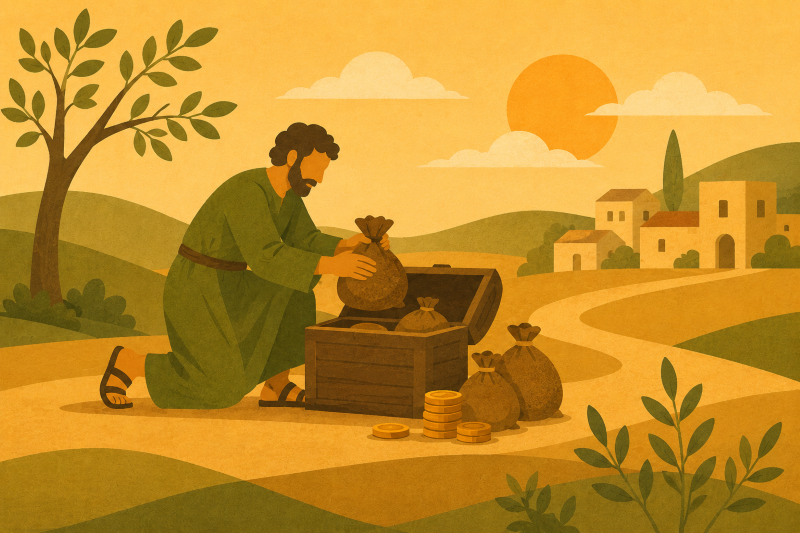
“It will be as when a man who was going on a journey called in his servants and entrusted his possessions to them. To one he gave five talents; to another, two; to a third, one—to each according to his ability. Then he went away. The man who received five talents went off at once and traded with them, and made another five. Likewise, the man who received two made another two. But the man who received one went off and dug a hole in the ground and buried his master’s money“
(Mt 25:14-18)
Investing to Generate Resources
In Italian, the word fundraising is often translated as “raccolta fondi” (fund collection). However, this definition is not entirely accurate.
The English term raising, in fact, does not only mean “to collect,” but “to grow,” and it is precisely here that one of the most profound aspects of fundraising lies: we must not limit ourselves to receiving resources, but we must create the conditions for them to continue to grow and generate additional value over time.
The fundraising process cannot be reduced to a simple financial request; rather, it must be viewed as a process of growth. Growth in relationships, trust, sustainability, and consequently, in the resources available for the mission.
Precisely from this perspective, the Parable of the Talents (Mt 25:14-30) offers us an extremely relevant interpretive key.
In the Parable, the master entrusts his servants with different amounts of talents, coins of great value. Two of them invest and multiply them. The third, however, chooses to bury what he has received. Upon his return, the master rebukes the servant who, out of fear of losing it, decided not to put his talent to work.
The servant thought to preserve what had been given to him to avoid risk, to prevent mistakes. A dynamic that, even today, affects many nonprofit organizations.

Fundraising Does Not Detract from the Mission
In the Third Sector, especially in less structured organizations, there is often a certain cultural difficulty in truly investing in fundraising. Investment comes more easily in operational or project activities, while everything related to fundraising, communication, donor care, or organizational development is perceived as a cost.
Yet fundraising works exactly the opposite way. To generate new resources, investment is required.
Time is needed to build relationships with donors. Skills are needed to communicate a cause effectively. Tools are needed to manage data and accompany people over time. Dedicated personnel are needed to nurture relationships.
Without this initial investment, a fundraising effort can hardly grow in a stable manner and truly provide sustainability.
Many organizations, however, remain trapped in a logic very similar to that of the third servant: “better not to spend, better not to risk, better to preserve what we have.”
But the Parable also reminds us that the buried talent produces nothing.
One of the great misconceptions in the nonprofit sector is thinking that investing in fundraising means taking resources away from the mission. In reality, the opposite often occurs.
Conducting fundraising in a structured manner allows the mission to become sustainable, continuous, and capable of growth.
A good campaign can generate new donors. A well-constructed donor care strategy can increase trust and loyalty. More effective communication can expand the community supporting a project. All of this requires investment.
The Parable of the Talents reminds us of precisely this principle: the donations collected are not meant to be simply safeguarded, but to generate additional value.
Creating Value Over Time
Naturally, this does not mean that every expenditure is automatically justified. The Parable does not exalt imprudence or improvisation. Rather, it speaks of responsibility and the capacity to generate fruit.
Even in fundraising, investing does not mean spending without criteria, but using resources strategically to create sustainability over time.
There is an important difference between a cost that consumes resources and an investment that allows resources to grow, and it is probably here that many organizations today are called to make a cultural leap.
The Parable of the Talents, read from the perspective of fundraising, places at the center a very concrete question: are we simply managing what we have, or are we creating the conditions for the gift to generate value over the long term?
Because the real risk is not investing and making mistakes. It is ceasing to invest out of fear of growing what has been entrusted to us.