“Building a world in which everyone can ‘flourish’ requires courageous co-responsibility. No single hand is sufficient to bear the weight of the challenges facing the world, and none is so weak that it cannot offer its own contribution”
(Pope Leo XIV, Magnifica Humanitas, n.13)
Courageous Co-responsibility
In his first encyclical, Magnifica Humanitas, Pope Leo XIV introduces the theme of courageous co-responsibility by recalling a biblical figure who is perhaps less known than others, but extraordinarily relevant today: Nehemiah.
Nehemiah is not a king, nor is he a prophet in the traditional sense of the word. He is a man who allows himself to be moved by the situation of his people. When he receives news from Jerusalem, he discovers that the city is still marked by the consequences of exile: the walls have been destroyed and the population lives in a state of great fragility and insecurity.
Faced with this reality, Nehemiah could have done what we often do: be moved, be indignant, comment, delegate, or perhaps write a post of protest if he had lived in our day. Instead, he decides to take on a shared responsibility.
Co-responsibility is born when a problem stops being “someone else’s” and becomes mine as well.
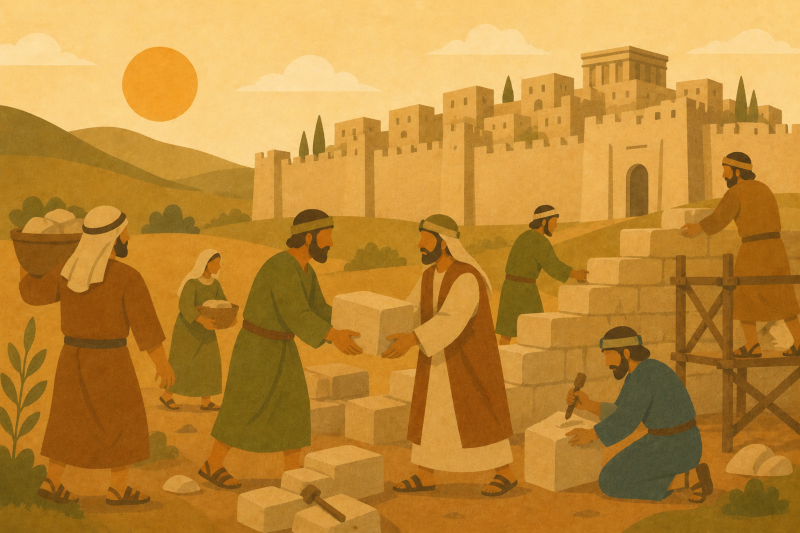
Nehemiah understands that the reconstruction of Jerusalem cannot depend on a single person. The walls are too extensive, the wounds too deep, and the challenge too great. For this reason, he does not try to do everything alone. “He does not impose solutions from above. He summons families, entrusts each with a section of the wall to rebuild, listens to fears, coordinates efforts, and faces opposition” (Pope Leo XIV, Magnifica Humanitas, n. 8).
The walls of Jerusalem are not rebuilt thanks to the intervention of an individual, but rather it is an entire community that takes on a common responsibility.
Community Fundraising
Reading Magnifica Humanitas, it is difficult not to think of one of the most important challenges facing non-profit organizations today.
Very often we are led to believe that the sustainability of a mission depends on the ability to find the necessary resources. Certainly, resources are important, but the story of Nehemiah seems to suggest something even deeper.
Great works are not born when we find someone willing to support them, but rather when a community recognizes that the work belongs to them. In other words, belonging comes before resources, participation before fundraising, and co-responsibility before the donation.
Today we use the expression community fundraising to describe the ability to involve a community around a shared cause.
But what does it concretely mean to build a community around a mission?
In community fundraising, people are considered active protagonists of change. It is not just about asking for a financial contribution, but about offering opportunities through which everyone can participate according to their possibilities.
Some will provide financial resources, others will offer their time for volunteer activities, others will become promoters of the cause, involving friends, family, and colleagues, while others will share professional skills, relationships, or spaces.
Ultimately, it is the same logic we find in the walls of Jerusalem: not everyone does the same thing, but everyone contributes to the same work.
For this reason, community fundraising uses tools whose primary objective is the involvement of people. Consider campaigns where the supporters themselves raise funds from their own network of relationships, community events capable of transforming a fundraiser into a shared experience, groups of volunteers who become promoters of a mission in their local area, or digital initiatives that allow people to share why they have chosen to support a particular cause.
Behind apparently different tools lies the same intuition: people are more likely to support what they feel a part of.

To each “a section of the wall”
In reality, long before the expression community fundraising entered our language, Nehemiah had already demonstrated its power. Perhaps this is precisely one of the lessons that Magnifica Humanitas offers to those involved in fundraising.
Our communities do not only need supporters. They need people who feel part of a mission and who can recognize that that school, that shelter, that educational or pastoral project does not belong to someone else, but belongs to them as well.
In this sense, fundraising does not simply consist of raising funds. It consists of creating spaces for participation, transforming interest into involvement, and transforming a cause into a community.
Therefore, community fundraising does not represent a novelty for the Church. Rather, it can be read as a contemporary rediscovery of a dynamic that Christian communities have lived since their origins: different people, with different gifts, uniting around a common mission.
I believe it is precisely in this aspect that fundraising becomes a tool at the service of the mission: not when we simply ask for a donation, but when we help a community discover that everyone “has their own section of the wall to build” and the courage to begin doing it together.